
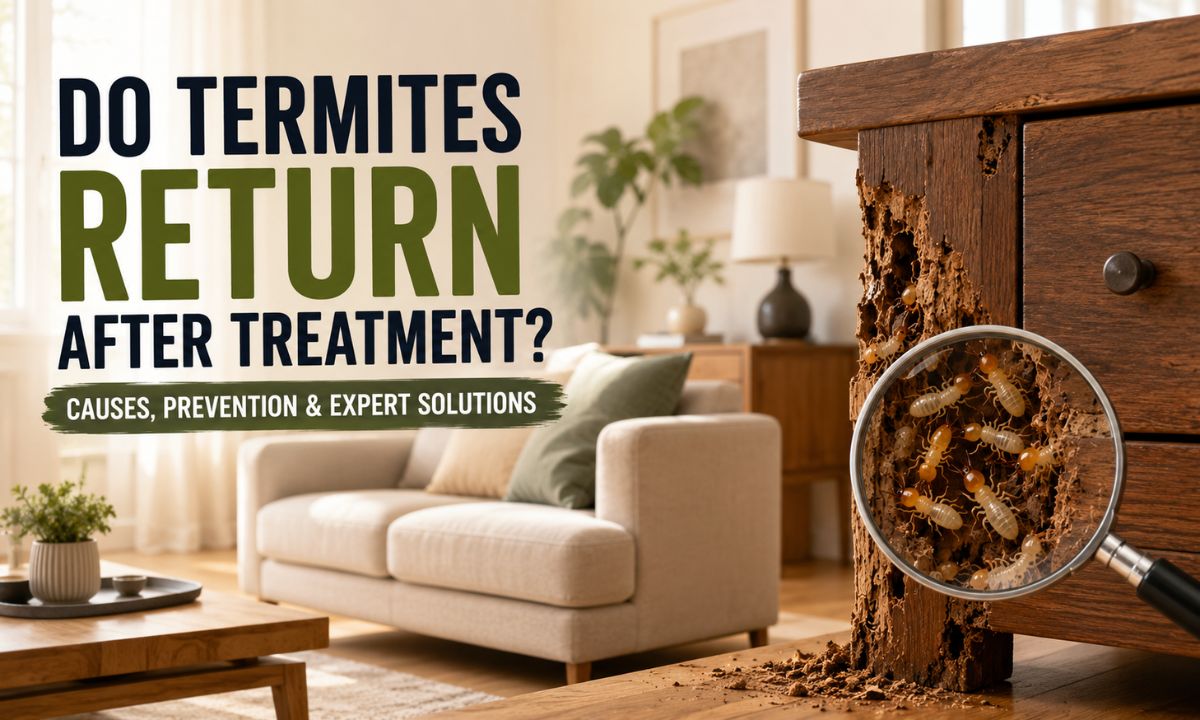
Do Termites Return After Treatment? Causes, Prevention & Expert Solutions
Termite treatment brings a huge sense of relief, especially for commercial property owners. But that relief can fade quickly when you notice signs of termites again. It’s a real concern. Therefore, many building owners and facility managers ask the same question: do termites return after treatment?
The honest answer is yes, they can. Termite treatment is not always a permanent solution. Without proper follow-up, regular inspections, and a few preventive steps, termites can re-enter your property and cause serious damage.
Be it managing a commercial complex, warehouse, or office building in Kolkata, this guide is for every property owner.
Can Termites Really Come Back After Treatment?
Yes, termites can return after treatment. Termite treatment works by creating a chemical barrier in the soil around your property, by applying termiticides to affected wood, or through baiting systems. These methods are effective only when applied correctly and maintained over time.
A single treatment does not guarantee lifelong protection from termites. Subterranean termites, the most common type in West Bengal, live underground and build large colonies. Even if a treatment kills a portion of the colony, surviving termites can find new entry points. New colonies from neighbouring land can also move in over time.
In commercial properties, the risk is higher. Large buildings have more entry points, more wooden fixtures, and more areas that are difficult to inspect regularly. Construction activity, plumbing work, or landscaping changes can all disturb the chemical barrier and allow termites to re-enter.
If you understand why termites come back, you can take a preventive step the moment you spot them in your property.
Why Do Termites Return After Treatment?
Several factors can lead to a termite reinfestation. Some are related to the treatment itself, while others are linked to the structure and environment of your property.
Incomplete Treatment Coverage
- Missed infestation areas: Termites can survive in untreated sections of a building. Even a small missed colony can lead to a full reinfestation within months.
- Hidden termite colonies: Many buildings have false ceilings, partition walls, or storage areas that are rarely opened. Termites can establish colonies in these hidden zones.
Breaks in the Chemical Barrier
- Soil disturbance: Digging, landscaping, or drainage work near the foundation can break the treated soil layer. Once the barrier is disturbed, termites can pass through freely.
- Construction work: Breaking ground, laying pipes, or disturbing the floor during construction projects can compromise the barrier.
Excess Moisture Around the Property
- Leaky pipes: Water leaking under floors, inside walls, or near foundations creates the damp conditions that termites prefer. Even a slow drip over time can attract termite activity.
- Poor drainage: If water collects around the base of your building, it softens the soil and makes it easier for termites to move upward into the structure.
Untreated Wooden Structures
- Wooden furniture: Untreated furniture, including office desks, chairs, shelving units, and storage racks placed against walls, gives termites a direct path into the structure.
- Door frames: If wooden door and window frames are not treated, they remain vulnerable even after the rest of the property is treated.
- Plywood: False ceilings, partitions, and storage cabinets made from plywood are highly attractive to termites. These are often overlooked during treatment.
Nearby Active Termite Colonies
- Neighbouring properties: If adjacent buildings or plots have active termite infestations, the colonies can spread underground and cross into your property over time.
- Trees and stumps: Old tree stumps, dead trees, or heavily wooded areas near your building can harbour large termite colonies.
Signs That Termites Have Returned
Spotting a reinfestation early can prevent serious structural damage. Here are the most important warning signs to look for.
- Mud tubes on walls: These are narrow, tunnel-like structures made of soil and termite secretions found along walls, columns, pipes, or at the base of structures. They allow termites to travel from the soil to the wood.
- Hollow-sounding wood: Knock on wooden panels, floors, doors, or furniture. If they sound hollow or papery when tapped, termites may have eaten through the inside.
- Swarmers (flying termites): When a termite colony matures, it sends out winged termites called swarmers to start new colonies. Seeing flying termites indoors, especially near light sources, is a strong sign of an active nearby colony.
- Discarded wings: After swarmers find a new site, they shed their wings. If you find small, translucent wings near entry points, know that it’s a sign that a new colony is establishing nearby.
- Damaged furniture: If you notice unexplained blistering, pitting, or surface damage on wooden furniture, check for termite activity underneath.
- Cracked paint or bubbling walls: Termites produce moisture as they work inside walls. This can cause paint to bubble, crack, or peel. Check for termite activity if it appears near wooden structures or the base of walls.
How Long Does Professional Termite Treatment Last?
Pre-construction treatment is the most effective form of protection. It is applied during the building phase, before walls and floors are completed. This involves treating the soil and foundation with termiticides before the structure is built on top. When done properly, pre-construction treatment can last up to 10 years or more.
Post-construction treatment is applied to an existing building. This is done by drilling into the floor and foundation, injecting termiticides into the soil, and treating affected wooden surfaces. Post-construction treatment generally lasts between 5 and 8 years. Annual inspections make it remain effective.
Several factors affect how long a treatment lasts:
- Soil type: Sandy or loose soil allows termiticides to disperse quickly, which can reduce the effectiveness of the barrier over time.
- Rainfall: Heavy rain can leach termiticides from the soil, reducing the barrier’s strength. Properties near low-lying areas or with poor drainage are at greater risk.
- Building structure: Buildings with multiple basement levels, extensive plumbing networks, or older foundations have more points where the treatment may break down or be difficult to apply uniformly.
- Treatment quality: The skill of the pest control team, the concentration of the termiticide, and the thoroughness of application all have a direct impact on how long the treatment lasts.
How to Prevent Termites from Returning
Prevention is more reliable and cost-effective than repeated treatments. Follow these steps.
Schedule Regular Inspections
Annual termite inspections are essential for commercial properties. Inspections cover the foundation, walls, plumbing areas, wooden fixtures, and surrounding soil. For older buildings or properties, twice-a-year inspections are worth considering. Hire a trained pest control expert for that.
Fix Moisture Problems
Address leaky pipes, blocked drains, and damp walls as soon as they appear. Improve ventilation in basements or lower floors to reduce the moisture levels that attract termites. In commercial buildings, regular maintenance checks for plumbing and drainage are required.
Remove Wood-to-Soil Contact
Wherever possible, avoid direct contact between wooden structural elements and the soil. Wooden posts, door frames set directly into the ground, and storage items placed on bare earth. Use concrete or metal supports to create a separation.
Seal Cracks and Entry Points
Inspect the exterior of your building for cracks in walls, gaps around pipes, and openings near the foundation. Termites can enter through very small spaces. Sealing these entry points with appropriate filler or sealant reduces the chances of termites finding a way in, particularly after the monsoon season when soil shifts slightly.
Maintain a Protective Termite Barrier
If your property has been treated with a soil barrier, make sure it is not disturbed. Avoid digging or landscaping work near the foundation unless necessary, and inform your pest control provider before any major construction or renovation work begins. Re-treatment of the barrier may be needed after significant soil disturbance.
Hire Certified Pest Control Professionals
Not all pest control services deliver the same quality of work. Choose a provider that uses licensed termiticides, follows proper application protocols, and offers a warranty or follow-up inspection service. Look for pest control companies registered with the Central Insecticide Board or with recognised industry certifications.
DIY Methods vs Professional Termite Control
Some property owners try to handle termite problems on their own. DIY products are available in the market. You can easily get sprays, powders, and baiting kits, which can provide short-term relief for minor infestations.
However, for commercial properties, DIY methods are not sufficient. Termite colonies can be extremely large, with hundreds of thousands of individuals spread across deep soil networks and hidden structural areas. Surface sprays do not reach the colony. Without treating the source, the infestation will return.
Professional termite control uses regulated termiticides that are applied at the correct depth and concentration to create a lasting barrier. Professionals also have the equipment to drill into floors, inspect concealed areas, and identify the species of termite, which matters because different species need different treatments.
DIY approaches may seem cheaper upfront, but repeated failed attempts cost more in the long run. For any serious or recurring infestation, professional termite treatment is the right choice.
When Should You Call a Termite Control Expert?
Some situations require professional attention without delay. Do not wait if you notice any of the following:
- You see mud tubes, swarmers, or hollow wood on your property after a previous treatment.
- You are planning a major renovation or construction project and want to ensure the termite barrier is not compromised.
- Your building is more than 5 years old and has not had a termite inspection in the last year.
- You are purchasing or leasing a commercial property and need an independent termite assessment before signing any agreement.
- Termites have caused visible structural damage to floors, walls, or support beams.
Why do termites return after treatment? Now that you know about it, don’t delay asking for help. go away on their own. The longer an infestation is left untreated, the more expensive and complex the repair work becomes. If you have any concerns about termite activity in your property, get in touch with a certified pest control professional.